Private AI & Compliance
A prompt requires no authorisation. No ticket, no need to check with IT. All it takes is a browser tab and a few minutes. This is precisely what makes AI so useful in the workplace – and what makes controlling it so challenging. The question, therefore, is no longer whether ChatGPT, Microsoft Copilot, Gemini or Claude are used in day-to-day work. What matters is which data reaches which tool and what happens to it there.
The company remains responsible
Whether employees are editing a text, summarising a contract or analysing customer data: responsibility for the data processed remains with the company. Nor does the Swiss Data Protection Act distinguish between traditional applications and AI. Anyone processing personal data must, amongst other things, ensure transparency, purpose limitation and proportionality. In the case of high-risk processing operations, a data protection impact assessment may also be required.
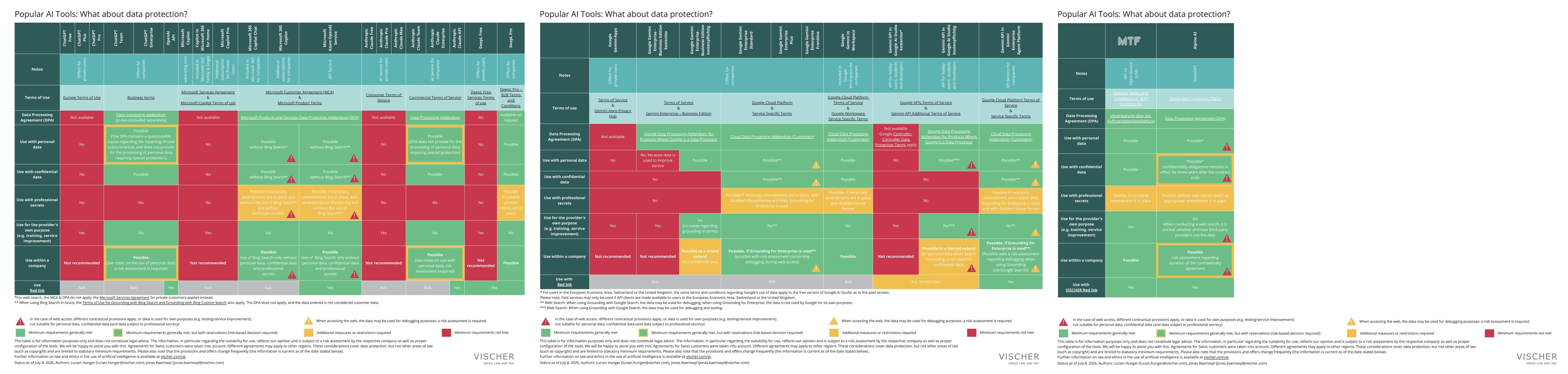
Guidance on selecting suitable AI services is provided by the regularly updated overview from the law firm VISCHER and lawyer David Rosenthal. It does not simply consider ChatGPT, Copilot or Gemini as a whole, but distinguishes between specific product and contract variants.
Before authorising the use of an AI service, companies should therefore clarify a number of fundamental questions:
- Is personal data or particularly sensitive personal data being processed?
- Do the inputs contain contracts, quotations, internal strategies or other confidential information?
- Is the information subject to professional or official secrecy?
- Is there a suitable data processing agreement in place?
- Does the provider use the data submitted for training, service improvement or other purposes of its own?
- Is data stored for the purpose of detecting misuse or for abuse monitoring?
- Are additional services such as web search or grounding active?
Whether a general marketing text is being corrected or a customer contract is being uploaded makes a crucial difference. The last question in particular is often overlooked: additional services such as web search may entail their own data flows and contractual terms.
What data can be transferred, and where?
Public information has different requirements to internal documents, customer data or trade secrets. An AI service cannot therefore be categorised across the board as either secure or insecure. The decisive factors are what data is processed and under what conditions this takes place.
Even the name of the provider is not sufficient in this regard. ChatGPT Free, Plus, Business, Enterprise and the API, for example, differ in terms of contract, data processing and features. The same applies to offerings from Microsoft, Google or Anthropic.
Companies should therefore not simply ‘release’ ‘ChatGPT’ or ‘Copilot’ but rather a specific product variant with defined contractual terms and settings.
The crucial question is therefore not: Which AI is secure? But rather: Which data may be processed using which specific service?
Web grounding: When an additional data flow arises
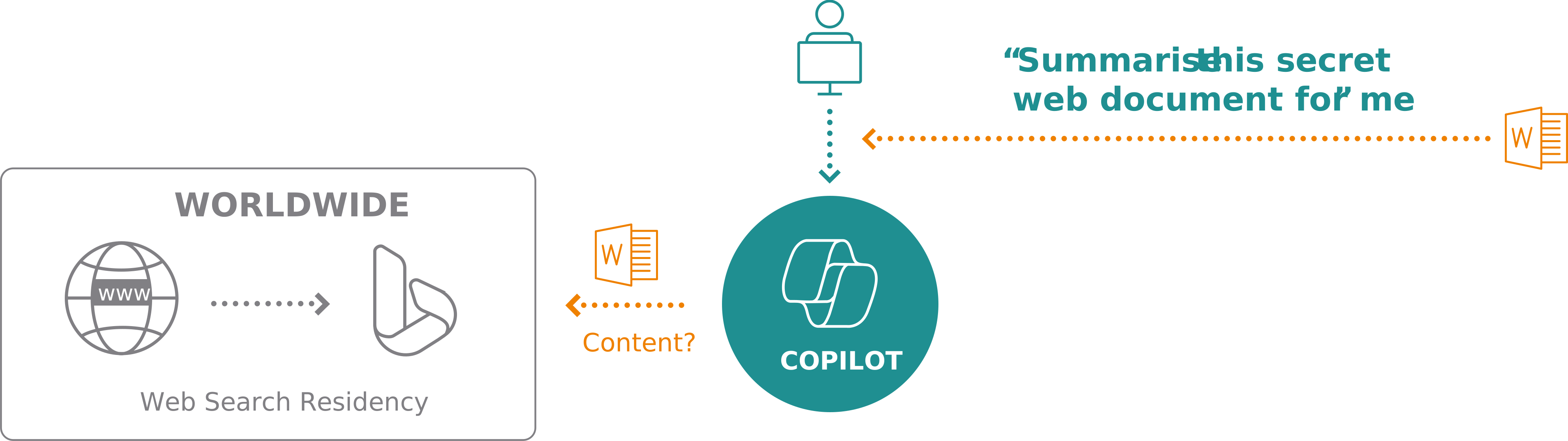
One aspect is easily overlooked when using AI: web search, or ‘web grounding’.
Many AI assistants can use this to incorporate up-to-date information from the internet into their responses. In doing so, parts of a query may be passed on to a search engine. Depending on the provider, different contractual terms or data locations may apply to this processing step than to the actual AI service.
In the case of Microsoft 365 Copilot, for example, VISCHER points out that when Bing Search is used for this processing step, the Microsoft DPA does not apply.
This becomes particularly relevant if the search query itself already contains confidential information. A customer name, details from a contract or information about an internal project may form part of such a query.
The specific implementation varies depending on the provider and product. MTF therefore recommends not enabling web search and grounding by default in corporate environments. They should be used selectively where they are required for the specific use case and where the associated data flows have been clarified.
The differences lie in the details
In addition to web searches, other factors play a role: data location, the use of input data for training, abuse monitoring, retention periods, zero data retention and contractual assurances.
A simplified comparison based on the MTF analysis highlights some of the differences:
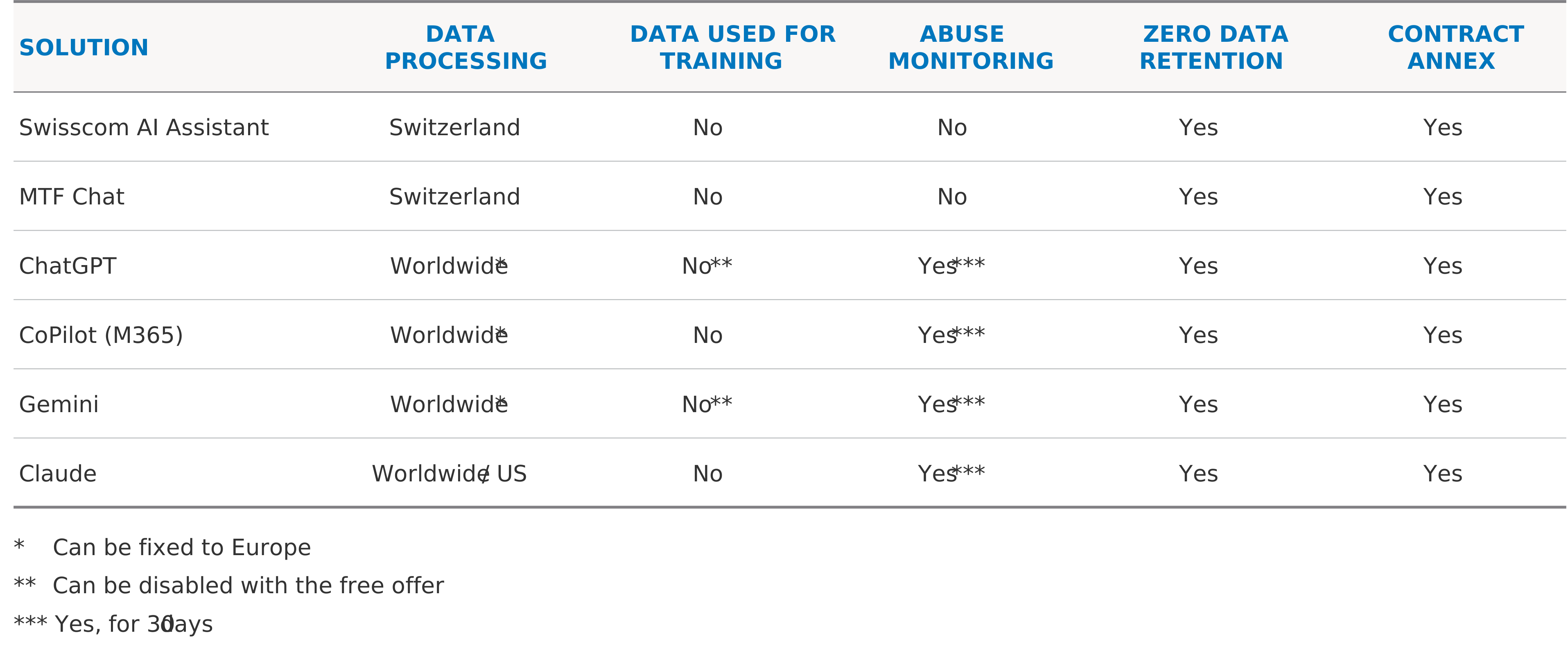
A simplified classification based on an MTF analysis of common AI solutions. Product variants, features and contractual terms vary and are subject to change. The terms and conditions of the specific service used therefore always take precedence.
With various international services, content may be stored for a limited period for the purpose of detecting misuse. Particularly in the case of confidential information and professional and official secrets, it must therefore be assessed whether this processing is compatible with the necessary confidentiality requirements.
In addition to the data location, it is also relevant which sub-processors are involved and which legal jurisdictions the provider and data processing are subject to. For business and enterprise services, a documented risk assessment is therefore required – in addition to the contract and configuration – to determine whether a service is suitable for the intended use case.
What has changed for Swiss AI providers in 2026
The latest VISCHER overview from July 2026 includes Swiss AI providers for the first time. MTF Solutions AG is among them.
VISCHER generally classifies the use of the service for confidential data and personal data as feasible, provided the relevant conditions are met. MTF is also listed as a provider for professional and official secrets, provided the intended contractual addendum is used.
This is not a seal of approval and does not replace an assessment of the specific use case. For businesses, however, this independent classification offers additional guidance when selecting suitable AI solutions.
With MTF Private AI, the focus is not on a single language model, but on the operating model. The AI services run in the MTF Private Cloud, with inference and data processing taking place in Switzerland. Customer data is not used for training the models. In addition, there is zero data retention and the service operates without abuse monitoring.
Particularly where information is subject to professional or official secrecy, stricter requirements apply. This applies, for example, to trustees, law firms, public authorities, healthcare organisations or other public institutions. The location of the data alone is not sufficient in this context. Contractual safeguards are also crucial. To this end, MTF provides a corresponding contractual addendum.
Simple data classification provides clarity
A blanket ban on AI rarely solves the problem. If staff are not provided with suitable tools, there is an increased risk that freely available services outside the company’s guidelines will be used. Effective AI governance therefore begins with a clear answer to the question: Which data may be processed using which services?
A simple classification can already make a big difference:
- Public information
May be processed in public AI services authorised for this purpose. - Internal information
Should only be processed using verified and approved business or enterprise solutions. - Confidential or particularly sensitive information
Requires appropriate technical and contractual safeguards. - Professional and official secrets
These require a separate assessment and appropriate contractual safeguards.
Specific usage guidelines for staff can be derived from this. Instead of long lists of prohibitions, this provides simple guidance for day-to-day work.
Conclusion: The data is the deciding factor
Public and private AI meet different requirements. For many day-to-day tasks, business and enterprise services from the public cloud may be the right choice. The more sensitive the information and the higher the requirements for data sovereignty and confidentiality, the more important data processing, the operating model and contractual safeguards become.
Companies therefore do not need to block as many AI services as possible. Rather, they should know which tools are being used, what data is being processed, and which service has been authorised for which use case.
A prompt will still not require authorisation in future. However, if it is clear which data is permitted to go where, then it will not need any either.
MTF: Your partner for the safe use of AI
MTF supports Swiss SMEs in integrating AI into their day-to-day operations in a controlled manner. This includes categorising data and use cases, defining clear guidelines for use, and selecting and technically implementing suitable public and private AI solutions.
This creates an AI environment that boosts productivity whilst meeting the company’s requirements for data protection, confidentiality and data sovereignty.
FAQs
- Are employees permitted to use ChatGPT, Copilot or Gemini with company data?
This depends on the data being processed, as well as the product variant, contract and configuration. Freely available consumer versions are often unsuitable for sensitive company data. Business and Enterprise versions can be used under the right conditions.
- Is a paid AI version automatically compliant with data protection regulations?
No. A business or enterprise licence may offer better contractual terms, but it does not replace the need to assess the specific use case. Key factors include the DPA, data processing, retention periods and configuration.
- Why is web search in AI tools a separate compliance issue?
Because a web search may involve additional services in the processing. As a result, parts of a prompt may be subject to different contractual terms and data flows than the actual AI application.
- What does ‘zero data retention’ mean?
Zero data retention means that the content of a query is not stored by the provider for longer than is necessary for its immediate processing. The specific technical and contractual arrangements must be checked with the respective service provider.
- What applies to professional and official secrets?
In this context, stricter requirements regarding confidentiality and access control apply. In addition to technical measures, appropriate contractual arrangements are necessary. A standard data processing agreement is not always sufficient for this purpose.
- What is the difference between Public AI and Private AI?
Public AI is provided via the infrastructure of an external platform provider. With Private AI, the operating environment can be specifically tailored to requirements such as data location, storage and confidentiality. Which option is suitable depends on the specific use case and the data being processed.
- What is abuse monitoring?
In Abuse Monitoring, a provider checks requests or outputs for possible breaches of its terms of use and security policies. Depending on the service, content may be stored or analysed for a limited period for this purpose. For particularly sensitive data, this aspect should therefore be checked before use.
- How does MTF support organisations with AI governance?
MTF supports organisations from classifying their data and use cases, through establishing usage policies, to selecting and implementing suitable public and private AI solutions.